
.svg)
Why Control Towers Fail Without Cross-Functional Ownership
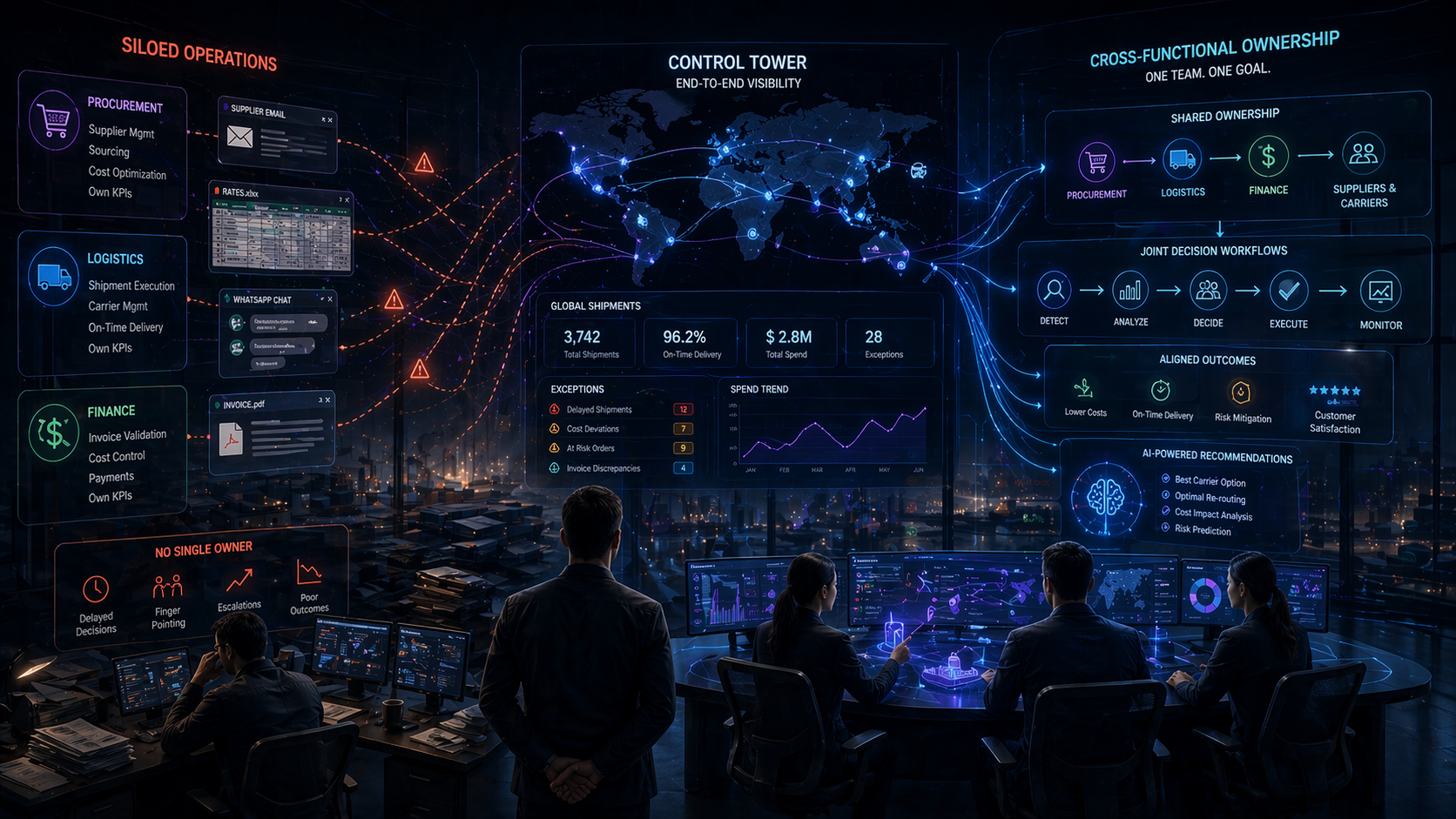
Control towers are built to unify the supply chain.
Yet in many organizations, they end up reinforcing the very silos they were meant to eliminate.
The dashboards are centralized.
The data is integrated.
But the decisions remain fragmented.
At the heart of this failure lies a simple issue: lack of cross-functional ownership.
The Illusion of a Unified System
Control towers promise a “single source of truth.”
But a single source of data does not automatically create a single source of decision-making.
In reality, supply chains operate across multiple functions:
- Procurement owns supplier relationships and sourcing decisions
- Logistics manages execution, carriers, and movement
- Finance governs cost validation, approvals, and payments
Each function operates with its own priorities, metrics, and systems of control.
When a control tower overlays visibility without aligning ownership, it creates a unified view of a fragmented reality.
Where It Breaks Down
1. Decisions Span Functions, But Ownership Does Not
A single shipment delay can trigger multiple decisions:
- Should procurement renegotiate terms with the supplier?
- Should logistics re-route or expedite?
- Should finance approve additional costs?
In most organizations, no single function owns this decision end-to-end.
Instead, it moves across teams, creating delays, misalignment, and inefficiencies.
The control tower surfaces the issue.
But it does not resolve who acts.
2. Functional KPIs Create Conflicting Incentives
Each team is measured differently:
- Procurement focuses on cost reduction
- Logistics focuses on service levels and on-time delivery
- Finance focuses on cost control and compliance
These priorities often conflict.
For example:
- The lowest freight rate may not be the most reliable option
- Expediting a shipment improves service but increases cost
- Rejecting an invoice may delay payment but protect margins
Without shared ownership, decisions are optimized locally, not globally.
3. Execution Still Happens Outside the System
Even when control towers provide visibility, execution often continues through:
- Emails and calls with forwarders
- WhatsApp messages with transporters
- Offline coordination between teams
This creates a disconnect between:
- What the system shows
- What actually happens
Over time, the system loses relevance to frontline teams.
4. No Accountability for Outcomes
When ownership is fragmented, accountability becomes diluted.
If a shipment is delayed or costs escalate:
- Procurement blames supplier performance
- Logistics blames carrier issues
- Finance questions approvals
The outcome is shared.
But responsibility is not.
Without accountability, the control tower cannot drive performance.
The Core Problem: Systems Without Ownership
Control towers are often designed as data aggregation layers.
But supply chains do not run on data.
They run on decisions, trade-offs, and execution.
If ownership of those decisions is not defined within the system, the system cannot influence outcomes.
It can only observe them.
Rethinking Ownership in the Control Tower
To make control towers effective, organizations need to move from functional ownership to workflow ownership.
1. Define Ownership Around Outcomes, Not Functions
Instead of asking “which team owns this,” the question should be:
“Who owns the outcome?”
For example:
- End-to-end shipment performance
- Total landed cost
- Supplier reliability
Ownership must be tied to these outcomes, even if execution spans multiple teams.
2. Embed Ownership Into Workflows
Ownership should not exist in org charts alone.
It must be built into the system through:
- Task assignment
- Approval workflows
- Escalation paths
Every exception, decision, and action should have a clearly defined owner within the platform.
3. Align Incentives Across Functions
Cross-functional ownership requires aligned KPIs.
This means:
- Balancing cost and service
- Measuring total supply chain performance, not functional efficiency
- Incentivizing collaboration, not siloed optimization
Without this, even the best systems will fail to drive the right behavior.
4. Enable Coordinated Execution
The control tower should act as a coordination layer where:
- Procurement, logistics, and finance operate within shared workflows
- Decisions are visible and traceable
- Actions are synchronized across teams
This eliminates the need for parallel systems of execution.
5. Introduce Intelligence to Guide Decisions
Cross-functional decisions are complex.
They require balancing multiple variables:
- Cost
- Time
- Risk
- Capacity
An intelligence layer can help by:
- Recommending the best course of action
- Highlighting trade-offs
- Benchmarking decisions against market data
This reduces friction and improves consistency.
6. Move Toward Autonomous Coordination
The next evolution is systems that not only recommend actions, but execute them.
AI-driven platforms can:
- Trigger RFQs and evaluate bids
- Re-route shipments based on risk signals
- Coordinate with suppliers and carriers
- Validate invoices automatically
This reduces dependency on manual cross-functional coordination.
Cross-Functional Ownership Is the Real Control Tower
A control tower is not defined by its dashboards.
It is defined by its ability to drive coordinated action across functions.
Without cross-functional ownership:
- Insights remain unused
- Decisions are delayed
- Execution is fragmented
With it, the control tower becomes:
- A system of accountability
- A platform for coordination
- A driver of performance
The Path Forward
Organizations that succeed will move beyond visibility and focus on ownership.
They will:
- Redesign workflows around outcomes
- Align teams around shared goals
- Embed decision-making into systems
- Leverage AI to reduce coordination overhead
Because in the end, the value of a control tower is not in what it shows.
It is in what it enables teams to do together.
