
.svg)
Rate Benchmarking 2.0: From Static Comparison to Continuous Pricing Intelligence
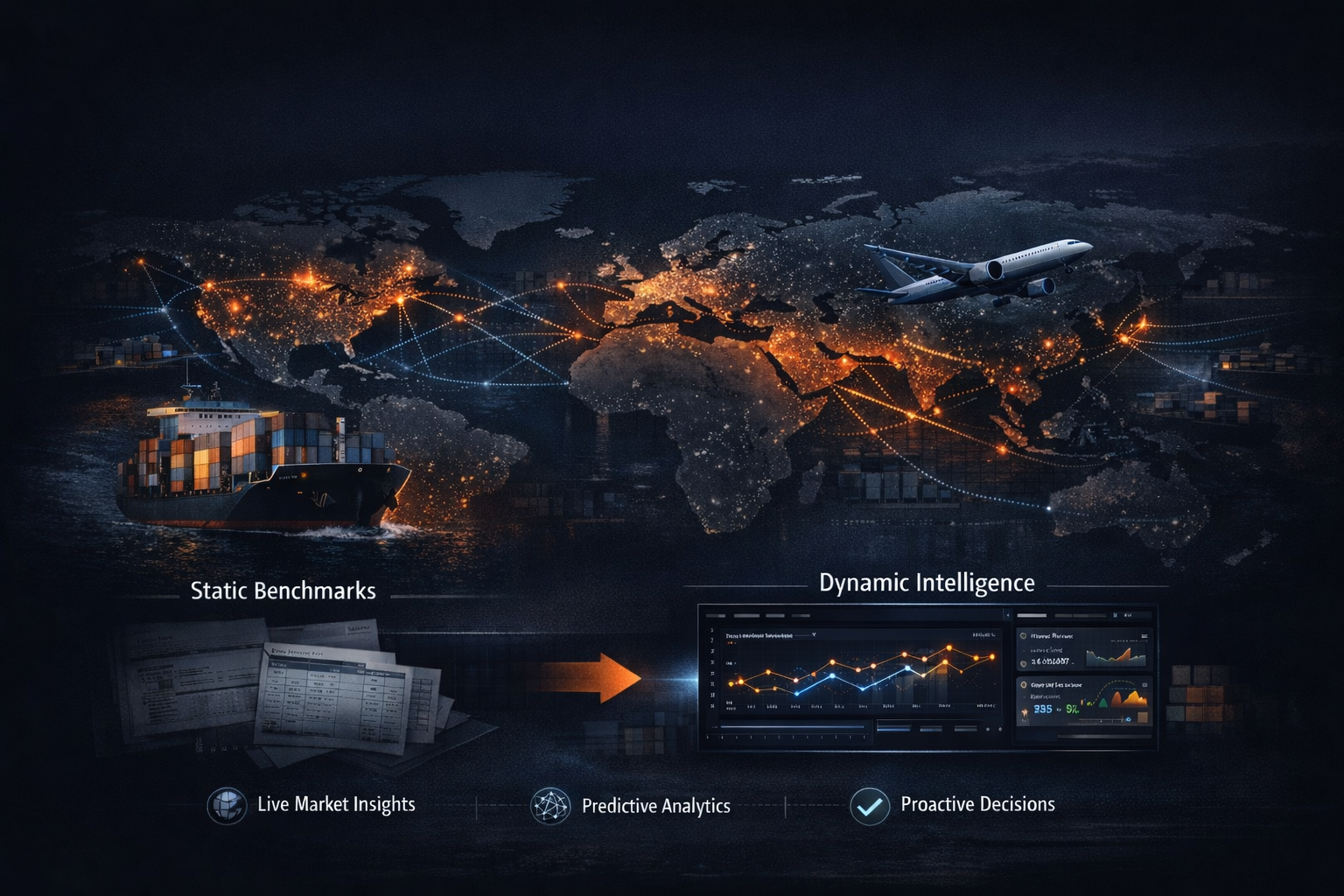
For years, freight procurement teams have invested in better rate visibility. Rate cards, quarterly benchmarks, market indices, and analytics dashboards have made it easier to see how prices compare across carriers, lanes, and time periods.
What these investments have not solved is the pricing decision itself.
Knowing that a rate is above or below a benchmark does not tell an organization whether it should be accepted, renegotiated, delayed, or rejected. Even when benchmark data is accurate, teams still struggle to decide what to do next, when to act, and how confident they should be in that decision.
As freight markets become more volatile, this gap between visibility and decision-making continues to widen.
Why Traditional Rate Benchmarking Falls Short
Most rate benchmarking today is retrospective.
Benchmarks are built from historical data, updated periodically, and reviewed during RFQs or audits. This approach assumes that market conditions are relatively stable and that the primary goal is comparison.
In reality, freight markets are dynamic. Fuel prices shift rapidly. Capacity is reallocated without notice. Congestion, blank sailings, currency movements, and regional disruptions can invalidate a benchmark in weeks, sometimes days.
Traditional benchmarking systems also strip away context. Rates are compared without fully accounting for reliability, congestion risk, service history, or downstream impact. A rate that looks expensive in isolation may be the right choice given customer commitments or inventory constraints. A cheaper rate may introduce hidden risk.
Because of this, benchmarking often becomes a reporting exercise rather than a decision-support capability. Teams still rely heavily on experience, judgment, and negotiation instinct to interpret what the data actually means.
The Real Problem: Static Benchmarks in a Dynamic Market
The core limitation is not data availability. It is the static nature of benchmarks.
Most systems treat benchmarks as reference points rather than living signals. They do not adapt continuously to market movement, nor do they provide guidance on timing, variance tolerance, or expected price direction.
As a result, organizations face familiar challenges:
- Overpaying because benchmarks lag the market
- Delaying RFQs while waiting for clarity that never arrives
- Debating rate validity instead of focusing on outcomes
- Auditing decisions after spend has already occurred
Benchmarking tells teams where a rate sits, but not whether it is the right decision now.
What Changes With Rate Benchmarking 2.0
Rate Benchmarking 2.0 shifts benchmarking from a static comparison to a continuous pricing intelligence capability.
Instead of relying on periodic snapshots, benchmarks are continuously updated using live market signals, historical performance, and predictive modeling. The benchmark becomes dynamic, contextual, and forward-looking.
The question also changes.
Rather than asking, “Is this rate higher or lower than the benchmark?”
Teams ask, “Is this rate appropriate given current market conditions, expected movement, and operational context?”
This allows procurement to move from price validation to price judgment.
From Price Comparison to Decision Support
In a Rate Benchmarking 2.0 model, benchmarks are embedded directly into procurement workflows.
Incoming quotes are evaluated against live market distributions, not outdated averages. Variance thresholds are defined in advance, aligned to business risk appetite. Short-term rate movement signals help teams decide whether to lock rates now or wait.
Crucially, the benchmark is no longer isolated from execution. It is connected to shipment history, service reliability, and downstream impact. Decisions reflect not just price, but consequence.
This transforms benchmarking from an analytical artifact into an operational control mechanism.
Why This Matters for Procurement and Finance
For procurement teams, dynamic benchmarking reduces cycle time and negotiation friction. Decisions are made faster and with greater confidence, grounded in real-time market reality rather than intuition.
For finance and compliance teams, it creates traceability. Every rate decision can be explained, justified, and audited using contemporaneous data rather than retrospective rationalization.
Most importantly, it shifts the organization away from reactive cost control toward proactive pricing discipline.
How Organizations Should Think About Adoption
Adopting Rate Benchmarking 2.0 is not about deploying another dashboard. It requires a change in how pricing decisions are governed.
The first step is defining acceptable variance. Leadership must decide what level of deviation from market benchmarks is tolerable, and under what conditions exceptions are allowed.
The second step is embedding benchmarks within RFQ and approval workflows, not reviewing them after decisions are made. Benchmarking must influence action at the point of decision.
Finally, organizations need feedback loops. Awarded rates, performance outcomes, and market movement should continuously refine benchmark accuracy. Over time, this creates a self-correcting pricing system.
The Vectus Perspective
Vectus.ai views Rate Benchmarking 2.0 as a foundational capability for modern freight procurement.
Visibility alone does not prevent overpayment. Historical comparison alone does not create discipline. What organizations need is continuous, context-aware pricing intelligence that operates inside execution workflows.
Rate benchmarking should not be an event. It should be a living system—one that adapts as markets move, learns from outcomes, and supports confident decision-making at scale.
The future of freight procurement will not be defined by who negotiates hardest.
It will be defined by who prices with precision, timing, and context—every lane, every time.
