.svg)
Orchestration breaks when planning and execution diverge
Every supply chain leader has seen this pattern play out. A planning tool is introduced to improve forecasts, inventory policies, and scenario planning. An execution tool follows to manage transportation, warehousing, and order fulfillment. Finally, everything is “unified” by adding a data warehouse and analytics layer on top.
On paper, this architecture looks modern and comprehensive. In product demos, it often looks impressive. But once these systems are live, very little actually changes in day-to-day operations. Teams continue to firefight, ETAs are debated endlessly in meetings, and exceptions still live in spreadsheets, emails, and WhatsApp messages. Instead of speeding up decisions, the overall system often slows them down.
This is not a tooling problem. It is a systems design problem.
Visibility Is Not the Same as Control
Most supply chain transformations stop at visibility. Dashboards do a good job of explaining what has happened or what is currently happening. They tell teams which shipment is delayed, where inventory is sitting, or which ETA has slipped.
What dashboards do not do is decide what should happen next. Knowing that something is wrong does not mean the system knows how to respond. A dashboard can surface risk, but it cannot resolve it.
Without a mechanism to translate insights into actions, visibility becomes a passive observer. The supply chain continues to rely on manual coordination, follow-ups, and judgment calls spread across multiple teams and external partners. This is where many so-called control towers quietly fail.
The Analytics Glue Trap
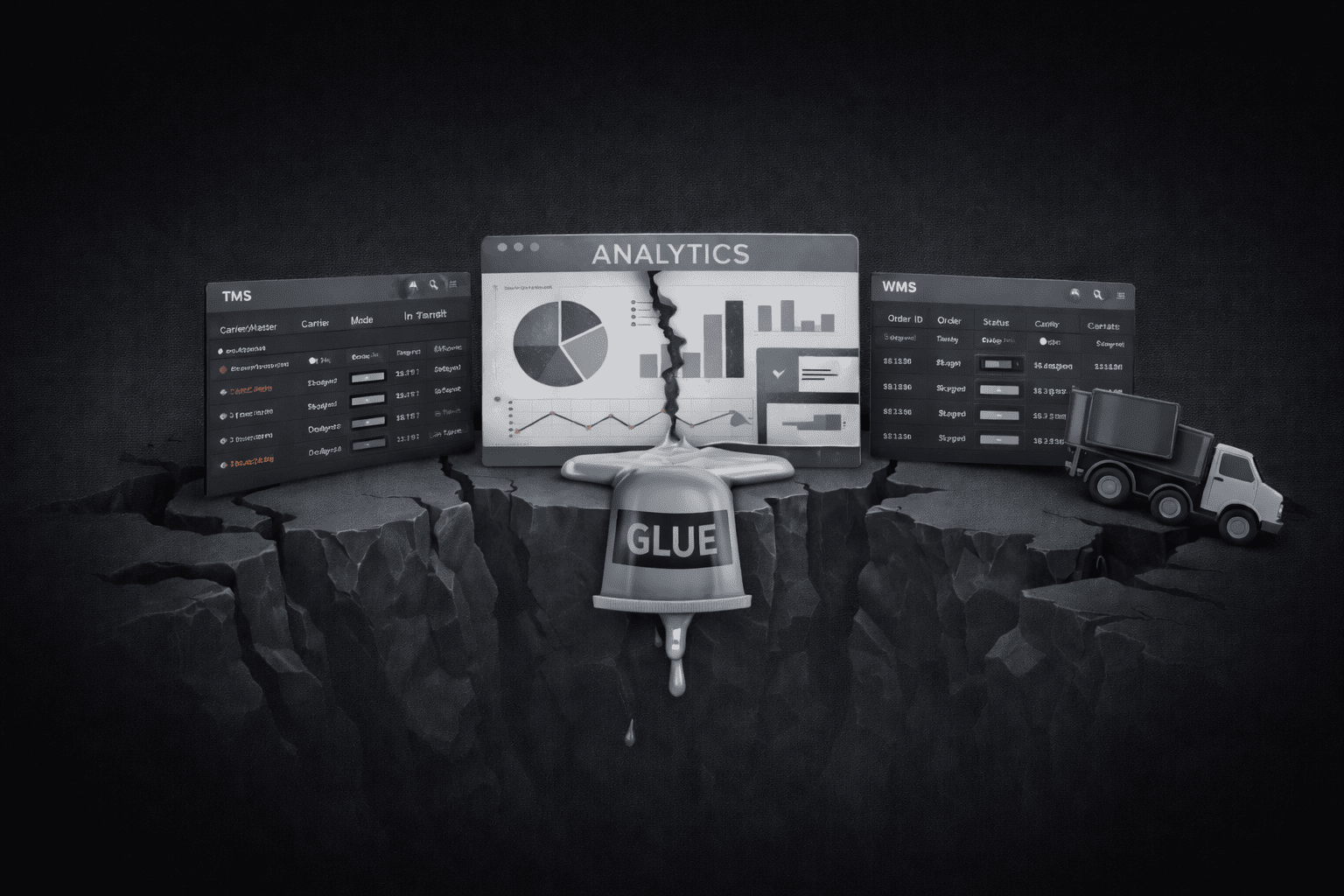
A common approach today is to “glue” analytics on top of execution systems such as TMS and WMS. The assumption is straightforward: if all data is centralized and visualized, better decisions will naturally follow.
In practice, the opposite often happens. Analytics becomes a fragile bridge between systems that were never designed to operate together in real time. When execution changes, reports lag behind reality. When plans shift, dashboards fail to trigger action. When exceptions occur, humans are forced to step in and manually intervene.
Instead of orchestration, organizations end up dealing with conflicting numbers across tools, delayed reactions to disruptions, and constant reconciliation between reports and what is actually happening on the ground. The glue holds only until it doesn’t, and when it breaks, the entire operating flow fractures.
Why Planning and Execution Drift Apart
Planning systems are designed to optimize intent. They answer questions about what should be done, what the optimal scenario looks like, and what the target cost or inventory outcome should be under a given set of assumptions.
Execution systems, on the other hand, deal with reality. They manage bookings, movements, status changes, documentation, compliance requirements, and vendor coordination as conditions change hour by hour.
When planning and execution are connected only through reports and dashboards, decisions are always late. By the time analytics highlights a problem, execution has already moved on. The result is a widening gap between what was planned and what is actually happening.
The Real Bottleneck Is Not Data
Most organizations do not suffer from a lack of data. They suffer from unclear ownership of decisions, slow approval loops, fragmented communication, and inconsistent responses to exceptions.
Adding more dashboards does not fix these issues. In many cases, it makes them worse by creating the illusion of control without the ability to act. Teams can see more, but they still cannot move faster.
What is missing is not visibility. What is missing is orchestration.
What Orchestration Really Means
Orchestration sits between knowing and doing. It defines how signals turn into decisions and how decisions turn into actions. It clarifies who should act, when they should act, and what should happen automatically versus what requires human approval.
Without orchestration, analytics remains descriptive. With orchestration, insights become operational outcomes. This is the difference between observing a supply chain and actually running one.
The Vectus Perspective
Vectus is built on a simple belief: a supply chain platform should not just show what is happening. It should help determine what happens next.
That means planning that feeds directly into execution, execution that continuously updates plans, and an orchestration layer that turns signals into actions. It means moving beyond dashboards stitched together with fragile glue and toward systems designed to operate end-to-end.
Visibility without control creates awareness, not outcomes. Modern supply chains do not fail because teams lack insight. They fail because insight is not connected to action.
