
.svg)
Lane-Level Risk Scoring: How to Build a Resilient Global Freight Network
Executive Summary
Supply chain disruptions rarely begin at scale.
They start as localized events—port congestion, weather delays, customs bottlenecks, or geopolitical shifts—and quickly cascade across lanes, carriers, and customers.
Yet most logistics networks are still planned using:
- Historical averages
- Static routing strategies
- Reactive visibility tools
The result:
- Repeated bottlenecks
- Rising logistics costs
- Missed service levels
- Limited resilience
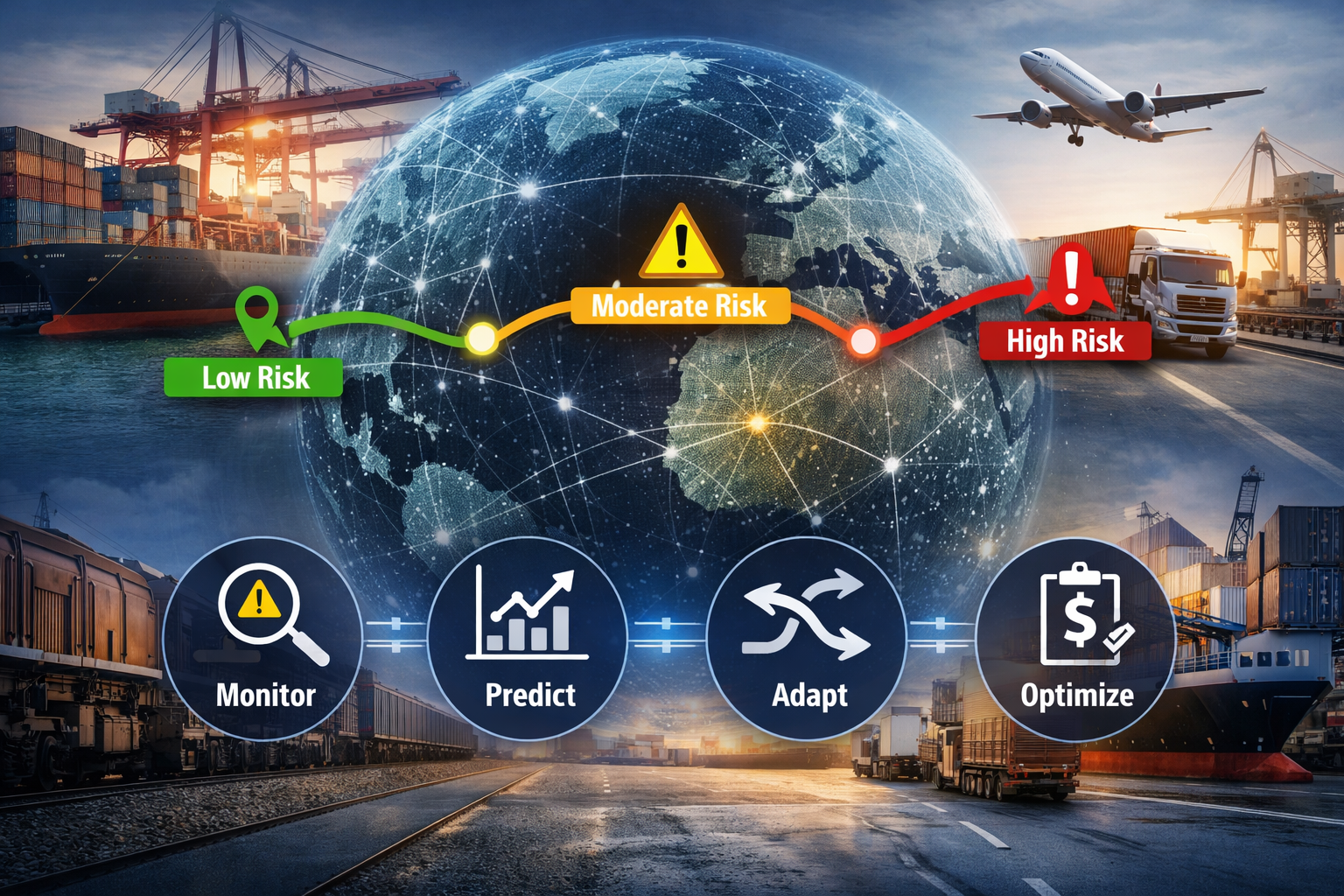
The next generation of supply chain performance is driven by lane-level risk intelligence—the ability to identify, measure, and act on risk at the individual trade lane level.
By combining real-time data, predictive analytics, and AI-driven orchestration, organizations can:
- Anticipate disruptions before they occur
- Optimize routing decisions dynamically
- Improve delivery reliability
- Reduce cost exposure
Why Supply Chain Resilience Starts at the Lane Level
A global supply chain is not a single network—it is a collection of thousands of individual lanes.
Each lane has its own risk profile based on:
- Geography
- Infrastructure
- Carrier performance
- Regulatory complexity
Examples of Lane-Level Variability
- Asia–US West Coast: port congestion and equipment imbalance
- Europe–Middle East: customs variability and documentation delays
- India–Europe: transshipment dependencies and dwell time risk
- North America cross-border: weather and clearance delays
Treating all lanes equally leads to:
- Inefficient routing decisions
- Excess buffer inventory
- Increased cost and variability
True resilience begins with understanding risk at the lane level—not at the network level.
Why Traditional Resilience Planning Falls Short
Most organizations still rely on outdated approaches to manage risk.
Common Limitations
Historical Averages
- ETAs and costs are based on past performance
- Fail to reflect real-time disruptions
Static Risk Models
- Updated quarterly or annually
- Quickly become irrelevant
Reactive Visibility Tools
- Identify delays only after they occur
Manual Re-Routing Decisions
- Slow and inconsistent
- Dependent on human intervention
Fragmented Data Sources
- No unified view across carriers, ports, and systems
The Business Impact
- High-cost disruptions concentrated in a small percentage of lanes
- Limited ability to anticipate or mitigate risk
- Increased operational and financial volatility
From Reactive Planning to Predictive Resilience
To build a resilient supply chain, organizations must shift from:
- Static planning
to:
- Dynamic, risk-aware decision-making
The goal:
Continuously evaluate and optimize each lane based on real-time risk signals.
This requires:
- Unified data across systems and partners
- Predictive risk modeling
- Automated execution workflows
The Vectus Approach: Lane-Level Risk Intelligence
Vectus enables organizations to build resilience from the ground up—lane by lane.
It continuously calculates dynamic risk scores across global trade routes, combining operational data, external intelligence, and predictive analytics.
How Lane-Level Risk Scoring Works
1. Multi-Source Data Integration
Risk intelligence is built on a comprehensive data foundation, including:
- Carrier performance and milestone data
- Port congestion and infrastructure metrics
- Weather and disruption feeds
- Customs and regulatory data
- Internal ERP and TMS records
This creates a unified view of all factors influencing lane performance.
2. Multi-Dimensional Risk Modeling
Each lane is evaluated across multiple dimensions:
Operational Risk
- Carrier reliability and transit variability
Infrastructure Risk
- Port congestion and handling efficiency
External Risk
- Weather events, strikes, geopolitical disruptions
Compliance Risk
- Customs delays and documentation errors
Financial Risk
- Cost deviations, surcharges, and accessorial exposure
Each factor contributes to a dynamic risk score that evolves in real time.
3. Predictive Risk Intelligence
Machine learning models analyze patterns across:
- Historical lane performance
- Current disruption signals
- Cross-lane dependencies
This enables early identification of:
- Potential delays
- Capacity constraints
- Cost escalation risks
4. Continuous Scoring and Visibility
Each lane is assigned a dynamic risk score, enabling teams to:
- Prioritize high-risk shipments
- Identify vulnerable trade routes
- Drill into root causes of disruption
Risk is no longer static—it is continuously monitored and updated.
5. Proactive Execution and Orchestration
When risk thresholds are exceeded, systems can:
- Trigger alternative sourcing or RFQs
- Recommend alternate carriers or routes
- Adjust booking priorities
- Update financial forecasts for cost impact
This ensures that risk intelligence translates into real operational action.
Business Impact of Lane-Level Risk Intelligence
Organizations adopting lane-level risk scoring achieve measurable improvements:
Faster Disruption Response
Identify and act on risks before they escalate
Improved On-Time Delivery
Optimize routing decisions based on real-time conditions
Reduced Cost Exposure
Minimize detention, demurrage, and accessorial charges
Better Carrier and Supplier Allocation
Shift volume toward more reliable lanes and partners
Enhanced Financial Visibility
Align cost forecasts with real-time risk exposure
Case Example: Improving Network Resilience
A global electronics manufacturer managing thousands of trade lanes faced recurring disruptions and cost variability.
Challenges:
- Limited visibility into lane-level performance
- Reactive response to delays
- Misalignment between logistics and finance
Solution:
By implementing lane-level risk scoring:
- All global lanes were mapped with dynamic risk profiles
- Predictive alerts identified high-risk shipments early
- Carrier allocations were optimized based on reliability
Results:
- Improved on-time delivery performance
- Reduced accessorial costs
- Better alignment between operational and financial planning
Key Insight:
Resilience improves when risk is measured continuously—not reviewed periodically.
The Future: Autonomous Supply Chain Resilience
The next evolution of supply chain management is moving toward autonomous resilience.
AI-driven systems will increasingly:
- Adjust risk thresholds dynamically based on seasonality and events
- Recommend proactive sourcing and booking strategies
- Simulate “what-if” scenarios across the network
- Quantify the financial impact of risk decisions
This creates a system that does not just react to disruption—but continuously adapts to it.
Conclusion
Supply chain resilience cannot be built on averages.
It requires continuous, real-time intelligence at the lane level.
By leveraging predictive risk scoring, organizations can:
- Identify disruptions before they occur
- Optimize decisions proactively
- Reduce cost and variability
- Build a more adaptive and resilient network
Vectus enables this transformation by turning fragmented data into actionable intelligence.
Because in modern supply chains:
Visibility shows where your freight is.
Risk intelligence shows where disruption will happen next.
And acting early is what defines true resilience.
