
.svg)
Detention and demurrage persist when action comes late
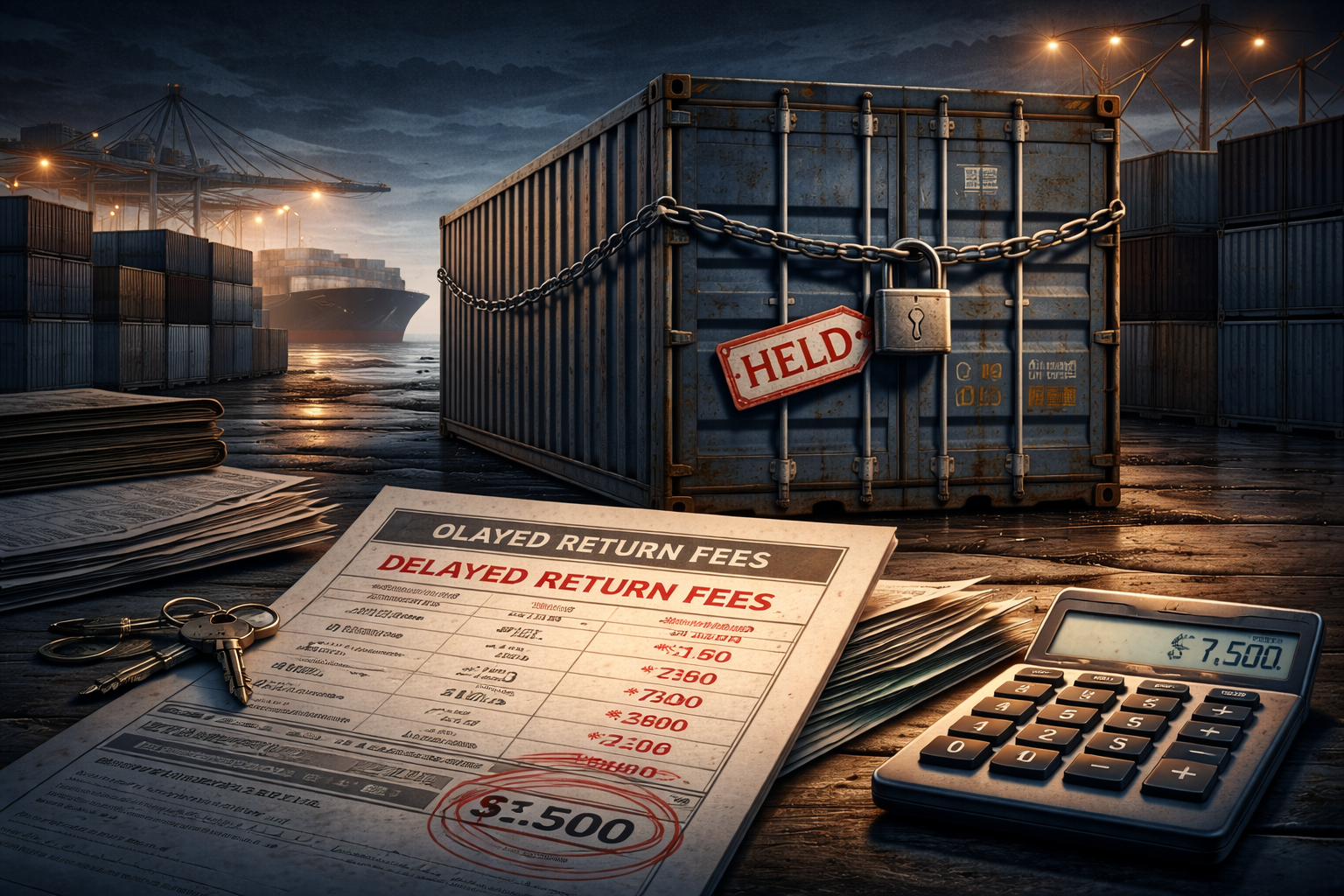
Detention and Demurrage Persist Because Supply Chains React Too Late
Detention and demurrage are rarely treated as strategic problems. They are often written off as the unavoidable cost of doing business in congested ports, fragmented ecosystems, and volatile trade lanes.
And yet, most of these charges are not inevitable.
They emerge quietly. A document submitted late. A truck appointment missed. A container left idle while teams wait for confirmation. By the time the invoice arrives, the outcome is already fixed. The only remaining question is whether the charge can be disputed.
For most organizations, that is where the conversation begins — after the cost has already been incurred.
Visibility Did Not Eliminate Detention and Demurrage
Over the last decade, supply chains have invested heavily in visibility platforms. Shipment milestones, port events, and container statuses are easier to see than ever before.
But despite this progress, detention and demurrage continue to rise.
The reason is simple. Visibility explains what happened. It does not prevent what is about to happen.
Knowing that a container is approaching free-time expiry does not reduce cost unless someone is alerted early enough, knows they own the decision, and is empowered to act. In many organizations, none of those conditions are reliably met.
As a result, dwell time accumulates while responsibility remains unclear.
Detention and Demurrage Are a Coordination Failure
Most D&D charges are not caused by a single mistake. They are caused by handoffs.
A forwarder waiting on documents.
A customs broker waiting on clarification.
An operations team waiting on carrier confirmation.
Each party sees part of the picture. No one owns the outcome end-to-end.
Traditional workflows make this worse. Email threads replace systems. Spreadsheets track free time manually. Escalations happen informally, often when it is already too late to change the result.
What looks like a cost problem is actually a workflow problem.
Why Traditional Tools Struggle to Prevent D&D
Legacy systems were not designed to manage dwell time as a first-class risk.
They record events after they occur.
They rely on static ETAs that ignore port congestion realities.
They separate documents, contracts, execution, and invoices into different systems.
As a result, the signals that matter most — approaching free-time expiry, delayed clearance, missed pickup windows — are detected too late and acted on inconsistently.
The system reports the issue. Humans are expected to resolve it.
This is not a failure of effort. It is a failure of design.
Prevention Requires Anticipation, Not Disputes
Reducing detention and demurrage does not start with better invoice audits. It starts with anticipating risk while there is still time to intervene.
That means identifying which containers are likely to breach free time days in advance, not hours.
It means triggering actions automatically, not relying on manual follow-ups.
It means assigning ownership clearly, before escalation is needed.
When delays are predicted early, trucks can be rescheduled, documents prioritized, and exceptions handled deliberately instead of reactively.
The cost disappears not because it was recovered, but because it never materialized.
From After-the-Fact Recovery to Proactive Control
In many organizations today, detention and demurrage are managed outside the system. Teams rely on experience, memory, and constant vigilance to avoid charges.
This does not scale.
A more resilient approach embeds prevention directly into execution. Signals trigger workflows. Ownership is explicit. Escalation paths are predefined. Decisions happen where the data lives.
This is the difference between monitoring dwell time and controlling it.
The Vectus Perspective
Vectus approaches detention and demurrage as a system behavior, not a billing issue.
By combining predictive ETAs, integrated document intelligence, and workflow orchestration, Vectus enables teams to act before dwell time turns into cost. Alerts are contextual. Accountability is clear. Actions are coordinated across stakeholders.
The goal is not to dispute faster.
The goal is to intervene earlier.
Detention and demurrage will not disappear from global trade. But their impact can be dramatically reduced when supply chains stop reacting to charges and start designing for prevention.
The shift is subtle, but decisive.
From hindsight to foresight.
From recovery to control.
