
.svg)
Beating Port Congestion With Predictive ETAs
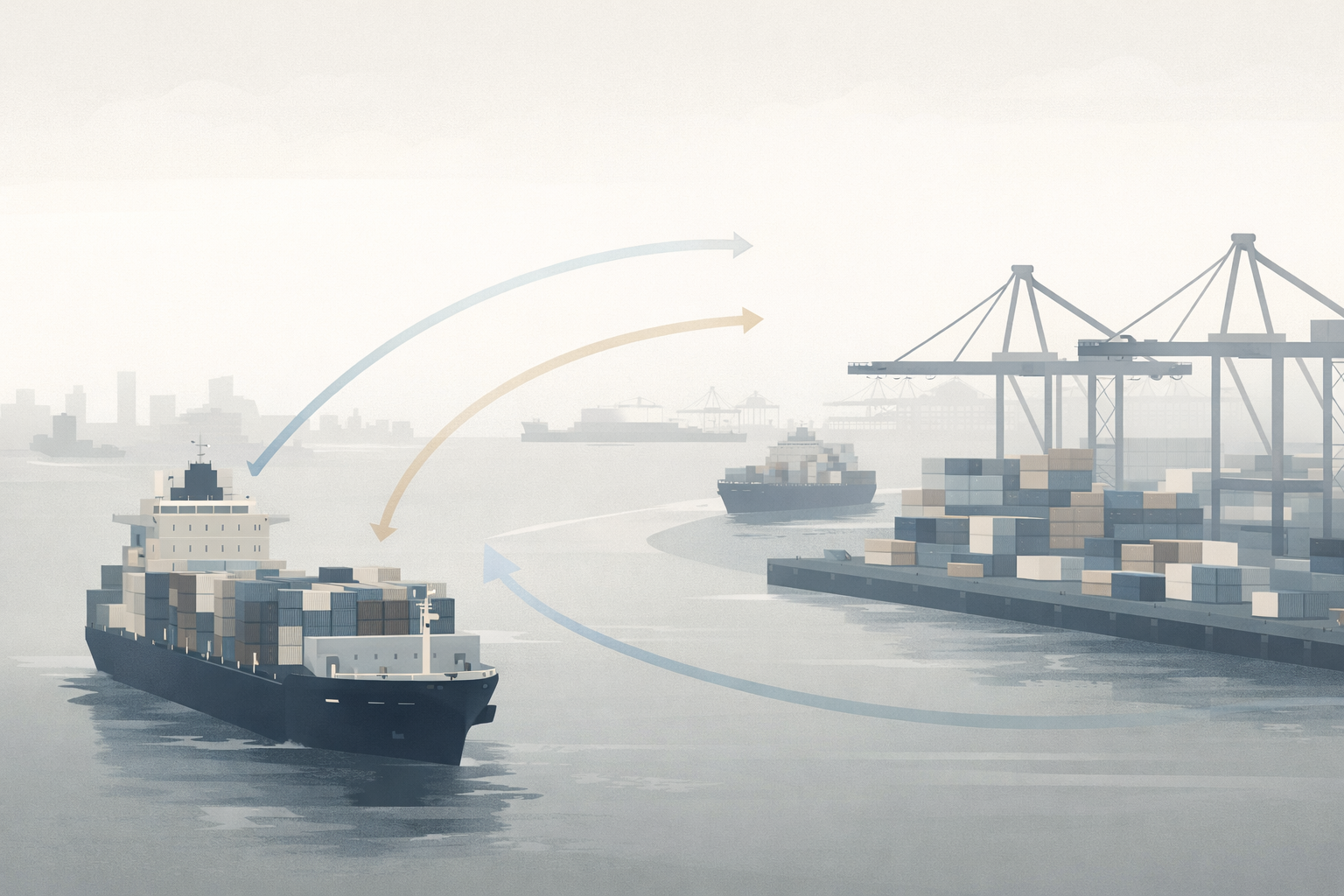
Beating Port Congestion Requires More Than Visibility
Over the last few years, port congestion has become a permanent fixture of global trade. Volumes continue to rise, infrastructure expands slowly, and disruptions - weather, labor, geopolitics - arrive without warning. Most supply chains are no longer surprised by congestion.
And yet, they are still caught off guard by its impact.
Containers arrive late. Free time is missed. Detention and demurrage accumulate quietly. Downstream teams scramble to react once delays are already irreversible. The issue is visible, but the response is late.
The problem is not a lack of data. It is the way ETAs are defined, trusted, and used.
Why Traditional ETAs Fail in Congested Ports
Most ETA calculations still rely on static assumptions. Carrier schedules, periodic updates, and manual checks form the backbone of arrival forecasting. These methods were sufficient when variability was low and buffers were generous.
They are no longer fit for reality.
Ports do not operate on schedules. They operate on constraints - berth availability, yard density, labor shifts, weather windows, and queue dynamics. Static ETAs ignore these forces entirely. By the time a carrier update reflects a delay, the downstream consequences are already locked in.
What organizations call “visibility” is often just delayed confirmation.
Seeing Delays Is Not the Same as Anticipating Them
Modern control towers can show congestion clearly. They display vessel queues, port backlogs, and delayed arrivals with impressive precision. But visibility alone does not answer the most important question:
When will this container actually be available for pickup?
Without that answer, teams cannot plan drayage, adjust production schedules, reallocate inventory, or intervene early enough to avoid cost. The system reports the delay, but it does not change the outcome.
This is where traditional ETAs quietly break down. They describe what was supposed to happen, not what will happen next.
Predictive ETAs Shift the Question From “Where Is It?” to “What Happens Now?”
Predictive ETAs take a fundamentally different approach. Instead of trusting schedules, they learn from reality.
By combining live AIS vessel data, weather patterns, port congestion signals, berth behavior, and historical lane performance, predictive models estimate arrival based on how ports actually operate under stress - not how they are planned on paper.
The result is not perfect certainty. It is usable foresight.
A forecast that is directionally right days earlier is far more valuable than a precise update that arrives too late to act on.
Why Accuracy Matters Only If It Drives Action
More accurate ETAs are not valuable on their own. Their value comes from what they enable.
When delays are predicted early:
- Drayage and pickup windows can be rescheduled before free time expires
- Inventory can be reprioritized before shortages occur
- Customers can be informed proactively instead of reactively
- Exceptions can be handled systematically instead of manually
This is how predictive ETAs reduce detention and demurrage, not by disputing invoices later, but by avoiding the conditions that create them in the first place.
From Reactive Exception Handling to Proactive Control
In most organizations today, ETA exceptions still live outside the system. They move into emails, calls, and spreadsheets because the platform does not tell teams what to do with the information.
Predictive ETAs change this dynamic only when they are embedded into execution workflows.
A delay forecast should automatically trigger:
- Risk flags tied to cost exposure
- Clear ownership for response
- Predefined actions or escalation paths
Without this, predictive insights remain advisory. With it, they become operational.
The Vectus Perspective
Vectus treats predictive ETAs as a decision input, not a visibility feature.
By integrating pETAs directly into procurement, execution, and audit workflows, Vectus ensures that arrival predictions do not stop at awareness. They drive action - rescheduling, reprioritization, escalation, and intervention - before congestion turns into cost.
Ports will remain congested. Variability will not disappear.
The advantage will belong to supply chains that stop reacting to delays and start planning around them - not by seeing more, but by anticipating earlier and acting decisively.
Predictive ETAs are not about knowing where a vessel is.
They are about knowing what to do next - while there is still time to matter.
