.svg)
Agentic AI in Supply Chains: From Insight to Action at Scale
For years, supply chains have invested in analytics, automation, and visibility platforms. These investments have made it easier to see what is happening across networks, systems, and partners. What they have not done is fundamentally solve the action problem.
Knowing that something is wrong is not the same as knowing what to do next. Even when insights are accurate and timely, organizations still struggle to respond consistently, quickly, and at scale. Decisions remain manual, fragmented, and dependent on individual experience.
This is where agentic AI begins to matter.
Why Traditional Automation Falls Short
Most automation in supply chains today is rule-based. If a condition is met, a predefined action is triggered. While this works for stable, well-defined scenarios, it breaks down in real-world environments where conditions are dynamic, exceptions are frequent, and trade-offs are constant.
Rule-based systems assume that the right response is always known in advance. In reality, supply chain decisions often require context, judgment, and adaptation. A delayed shipment might warrant expediting in one case, rerouting in another, or no action at all depending on customer priority, inventory buffers, downstream impact, and cost.
This is why many automation initiatives plateau quickly. They handle the easy cases and leave the hard ones to humans.
What Makes Agentic AI Different
Agentic AI shifts the role of systems from passive tools to active participants in decision-making. Instead of simply surfacing insights or executing fixed rules, agents are designed to reason, decide, and act within defined boundaries.
An agent does not just ask, “Is something wrong?” It asks, “What should be done now, given the current context, constraints, and objectives?”
In a supply chain setting, this means agents can evaluate multiple signals at once, understand trade-offs, and recommend or execute actions dynamically. They operate continuously, not just when a report is reviewed or an alert is acknowledged.
Crucially, agentic AI does not replace human oversight. It changes how humans interact with systems by shifting their role from constant decision-makers to supervisors of autonomous action.
Solving the Orchestration Problem
One of the biggest gaps in modern supply chains is orchestration. Planning systems decide what should happen. Execution systems record what is happening. Analytics explains what happened. What is missing is a layer that connects all three in real time.
Agentic AI fills this gap by acting as the connective tissue between insight and execution.
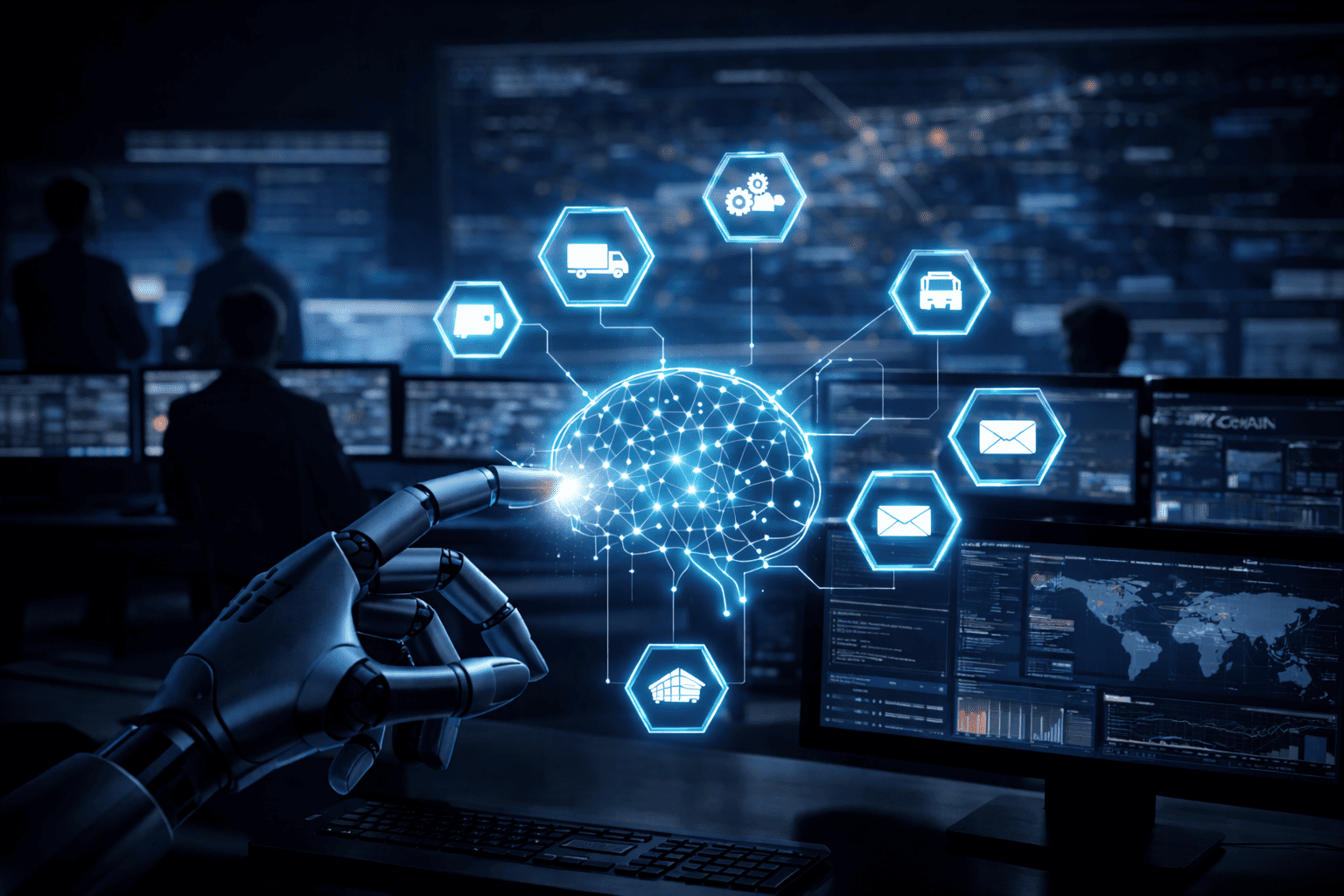
An agent can observe signals from planning, execution, and external data sources simultaneously. It can understand intent from plans, reality from execution, and risk from analytics. Based on this, it can determine the appropriate response and coordinate actions across systems.
This turns orchestration from a manual process into a continuous, system-driven capability.
From Alerts to Autonomous Action
Most organizations are already overwhelmed by alerts. Every delay, deviation, or risk generates a notification. Over time, teams learn to ignore them.
Agentic AI changes the unit of interaction. Instead of alerts, the system produces decisions or actions.
For example, rather than notifying a team that a shipment is delayed, an agent can assess downstream impact, evaluate alternatives, and either take corrective action automatically or escalate with a clear recommendation and rationale.
This reduces cognitive load on teams and ensures that attention is focused where it is truly needed.
How Companies Should Think About Adoption
Adopting agentic AI is not about adding another tool. It is about redefining how decisions flow through the organization.
The first step is clarity around decision boundaries. Leaders need to define which decisions can be fully autonomous, which require human approval, and which should remain manual. This is not a technology decision. It is a governance decision.
The second step is ensuring that agents are embedded within execution workflows, not layered on top as advisors. Agents must be able to act within TMS, WMS, procurement, and planning systems, not just recommend actions in a separate interface.
Finally, organizations need feedback loops. Agents should learn from outcomes, human overrides, and changing conditions. This is what allows autonomy to increase safely over time.
The Vectus Perspective
Vectus views agentic AI as the natural evolution of supply chain platforms. Visibility creates awareness. Orchestration creates coordination. Agentic systems enable action at scale.
Rather than forcing teams to constantly interpret dashboards and alerts, the platform should shoulder more of the decision-making burden while keeping humans in control of intent and oversight.
Agentic AI is not about removing humans from the loop. It is about removing humans from repetitive, reactive decision-making so they can focus on strategy, exceptions, and improvement.
The future of supply chains will not be defined by who has the most data. It will be defined by who can turn insight into action reliably, consistently, and autonomously.
